
"When does a user truly become 'sticky'?"

• motivation drops over time, and every friction point accelerates it; your job is to keep the tank full until the habit forms
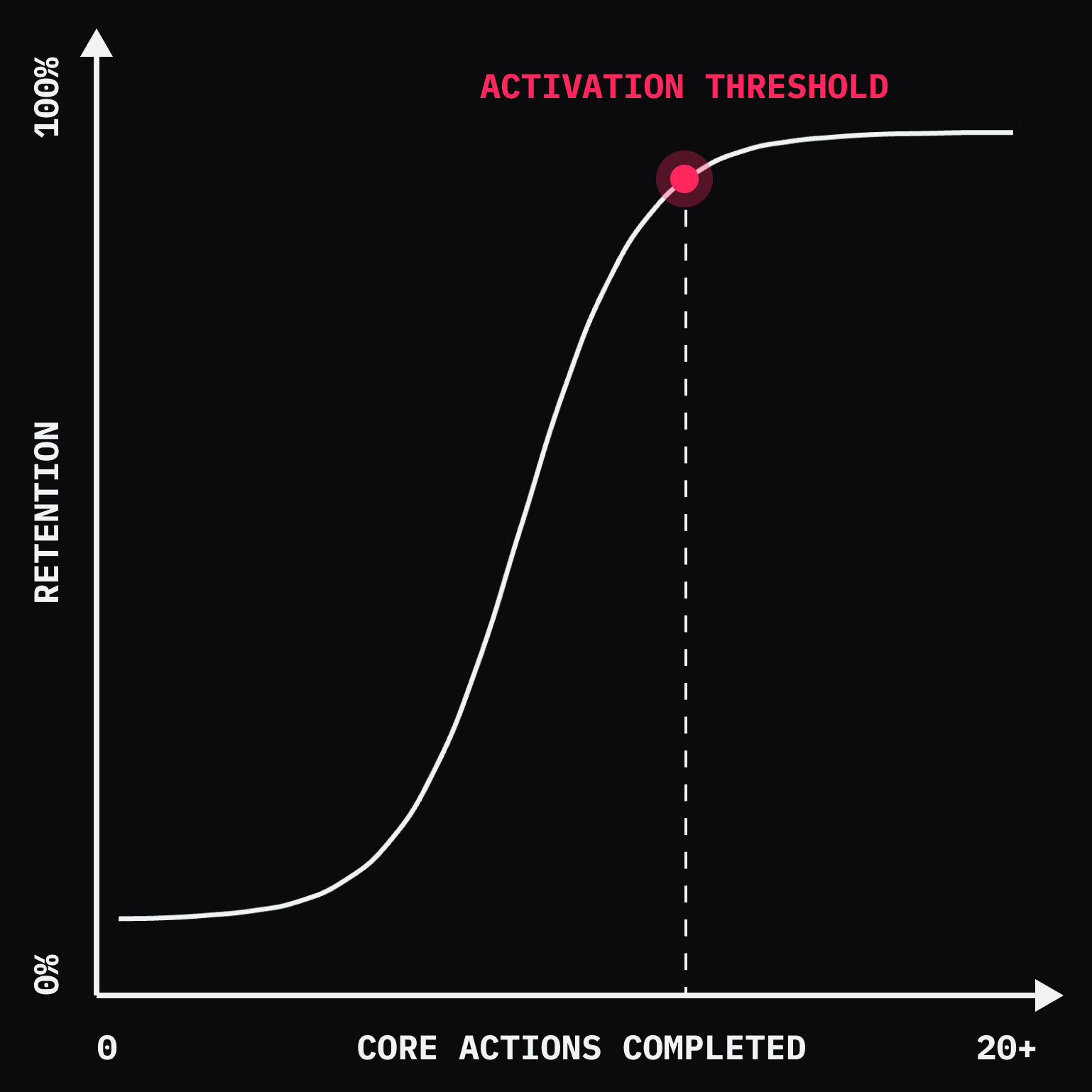
• that tipping point has a name: your activation threshold — the number of repeated core actions after which users tend to stick
• you can find yours by tracking core actions per user and plotting them against retention until a hockey-stick pattern emerges
To be clear upfront, there is no such thing as a universal stickiness tipping point formula for SaaS products.

But what we can do is look at what consistently keeps happening when users do become sticky. Let's do some reverse engineering:
A user becoming sticky means (in an ideal definition) they have:
- ditched the previous alternative they used to get the job done (a competitor product, a spreadsheet, whatever)
- adopted your product and made it their new, default way of doing that job
Both conditions require a certain (and variable) number of repeat sessions.
And for repeat sessions to happen, you need:
- a successful first session that gives them a reason to come back
- a "nudge" mechanism that reminds them to come back multiple times
- until they have formed a new habit (that replaced the old one)
We humans are habit creatures. Who hasn't struggled to stop what they considered a bad habit, and struggled even more to build a new, healthier one? As we say in French, "habits have a thick skin".
And because the human brain will do everything in its power to conserve existing habits and keeping us from building new ones, I see adoption and retention as a "don't f@#% up until they stick" series of events.

Stickiness is a matter of psychology and behavior (much more than you may think).
When they sign up, a user is usually quite motivated, curious and hopeful. They believe your product can help them achieve their goal in a more efficient/less painful way than their current option, and that it's easy to use.
But motivation drops with time. And it drops even faster when you add unnecessary or negative friction.
(note to myself: write a post on what exactly friction is)
Each time there is a glitch in the user journey, the motivation tank looses a few drops. And when it reaches a low level, the "churn" sign starts blinking above their head.
That's why on their first session, you not only need to deliver a first meaningful win to prove your product is actually working and delivering on the promised value (which will reinforce trust, motivation and their initial belief that your product can do good for them); you also need to avoid any unnecessary friction and negative emotions.
And you need to avoid "f@#%ing up" at each of the following sessions. And keep delivering value (that goes without saying).
This way you keep delivering value and positive emotions, and maintain the motivation tank as close as possible to full by avoiding undesirable glitches. You preserve the momentum that's needed for users to keep coming back to your product enough times enough for the new habit to build.
It's like dating. Each time you do or say something cringey, suspicious or whatever, you negatively impact trust, and trust directly impacts their motivation to meet you again.

All this explains why it's critical to get users to meaningful value asap, and to have a "engagement loop" system that keeps getting them back to your product.
Now I have some numbers for you...
The tipping point where a user becomes sticky is actually called the activation threshold (retention threshold would actually be better, no?).
The activation threshold is the number of repeated core actions after which users tend to become sticky.
For example, the team at Slack have found out 93% of users adopted the product long-term after sending 2,000 messages. That number became their activation threshold, and onboarding was all about getting each new user there.
Important caveat: the Slack team made correlations between repeat action numbers and long-term stickiness. But it's not a laws.
Here are a few other famous examples:
- Facebook: users who add 7 friends in 10 days are dramatically more likely to become long-term active users.
- Canva: an activation milestone example is completing and exporting a first design in the first session.
- Zenchef (restaurant SaaS): they treat “first reservation processed within 14 days” as the key activation milestone. Also taking more than 30 days to onboard doubles churn risk within six months.
- Typical SaaS activation rate: across ~500 products, the average activation rate is ~36% for SaaS, with a median of ~30% (Lenny Rachitsky’s survey and definition of “activation milestone”).
(sources: Productled, Perplexity)
"How do I find MY activation threshold?"
Here's a simple, pragmatic playbook I've been testing with few clients (early results: promising):
- define your core action: the one thing power users do repeatedly (ex: "send message" for Slack)
- track it per user, weekly: use your analytics to log frequency (you can even do it manually if you're early stage)
- plot retention curves: chart "X core actions → D7/D30 retention" until a hockey-stick pattern emerges.
At some point, you'll have enough data to start seeing a pattern.
Based on your product and what "regular" use frequency looks like, you should have enough data in weeks/months.
So...
There is no universal "tipping point" formula for stickiness, but it reliably emerges when users repeat your core action enough times to form a habit, typically 5-10+ sessions of value delivery without friction.
Your activation threshold is the repeatable milestone (ex: Slack's 2,000 messages) where retention "hockey-sticks" from ~20-30% to 80%+. It's found by plotting "core actions per user" against D30/D90 retention until the curve bends sharply.
What you can do:
Pinpoint your core action, track it weekly via cohorts, and optimize onboarding to get users there fast. That's when they ditch alternatives and default to you.
Hope this was helpful.
Senior Product Designer • Activation/Onboarding Specialist
Helping B2B SaaS founders activate, convert and retain more users
Let's talk → LinkedIn | fsimitchiev.com