
[🔬 onboarding dissection] DigiStorms top 3 activation moves

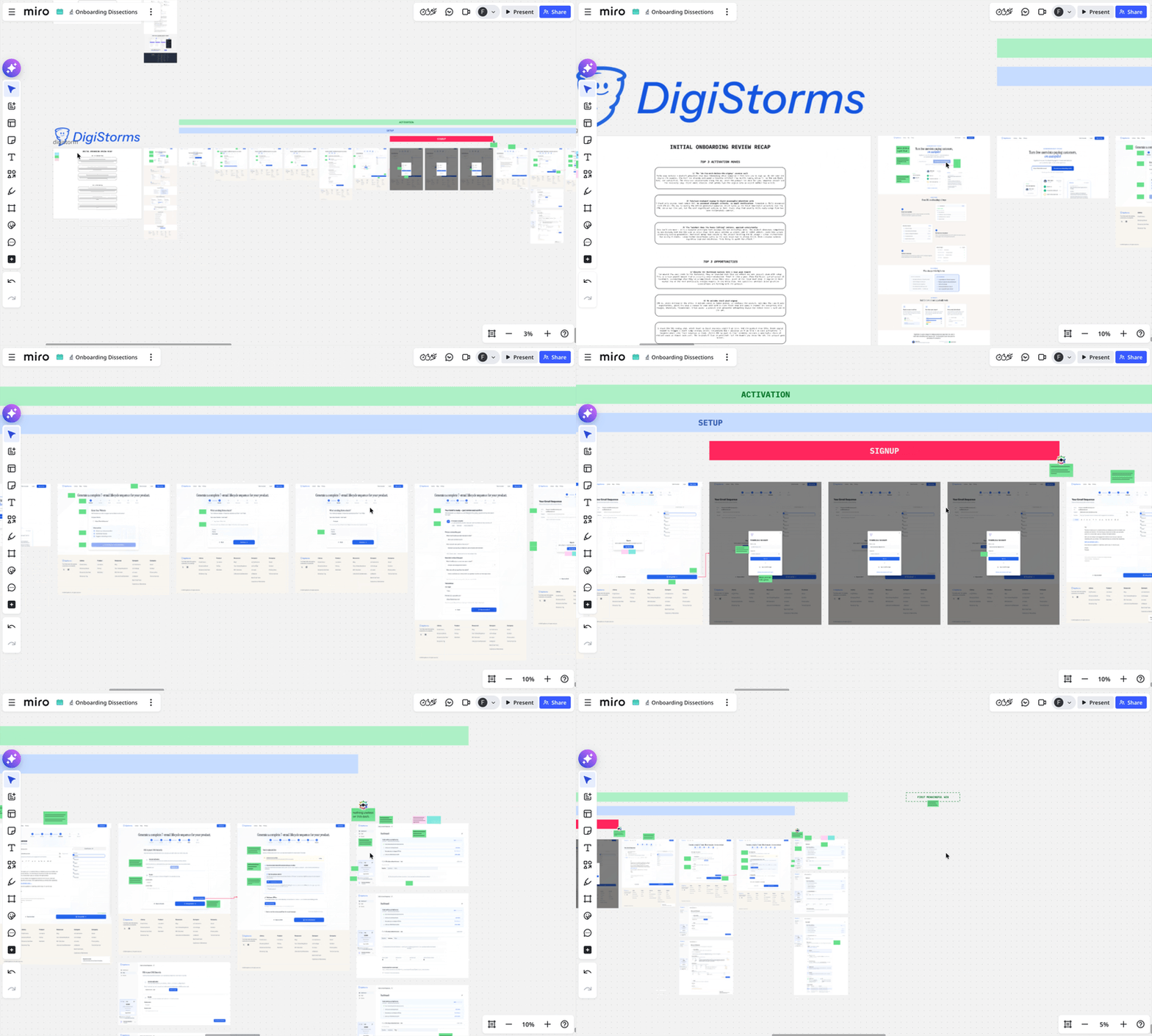
DigiStorms.ai is an AI-powered onboarding email generator. You paste your website URL, and the product produces a full sequence of 7 behavior-based onboarding emails tailored to your product, your tone and your users; ready to wire into your stack and push live.
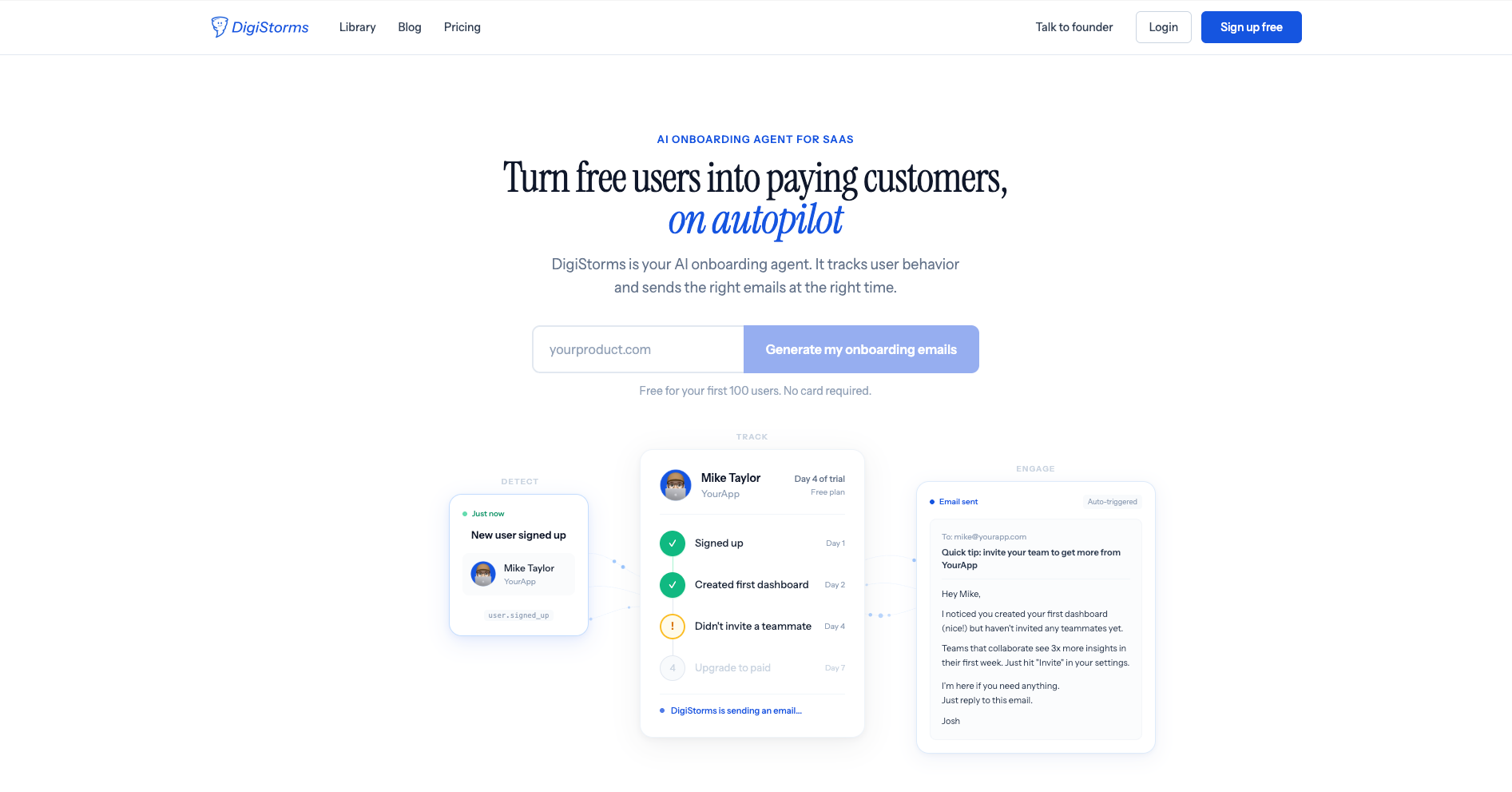
Now, you can probably guess why I had to dissect this one.
A product that builds onboarding emails for B2B SaaS... reviewed by a guy who eats B2B SaaS onboarding for breakfast. The meta layer alone made it irresistible. But what kept me digging is that DigiStorms gets something structurally right that most products in the AI-tool wave get wrong: it understands that the onboarding is the sales pitch.
Here's what strikes me the most about it:
DigiStorms doesn't ask you to trust it. It does the work first, generating your full email sequence from a single URL, and only then asks for the signup. By the time you're asked to commit, the product has already given value and built trust.
Here are the 3 activation moves DigiStorms gets right I think every B2B SaaS founder should look at, especially if your product can produce something from a single user input.
TOP 1 — Do the work before asking for the signup
Almost every B2B SaaS onboarding follows the same script:
signup → setup → eventually get some value.
The user has to trust that what's behind the gate is worth the signup gate (and potentially opt-in/out trial enrolment). That trust is expensive and many products burn it before they've earned it.
DigiStorms flips the script entirely:
You land on the homepage, paste your website URL, and the product gets to work. It pulls your value prop, generates a full onboarding email sequence tailored to your product. It shows you the first email, alive, in the background. And then only it asks you to sign up, to save your work and see the rest.
By the time the signup CTA appears, you're not deciding whether to invest in DigiStorms. You're deciding whether to unlock what it already made for you.
A few things stack to make this work:
- The IKEA effect kicks in early. The first email previews update live as you tweak inputs. You see your sequence taking shape with your words, your context, your tone. By the time you're done, it doesn't feel like the product's output. It feels like yours.
- A curiosity loop to keep you engaged. You can see email #1 in the background, just behind the signup form, not even blurred. And you can also see the 7 email list on screen. The signup isn't framed as a cost but as the next page of something you're already reading.
- The signup ask is fair game. The product has done real work for you (parsed your site, structured your sequence, drafted 7 emails). Asking for an email and password at this stage isn't extractive but reciprocal.
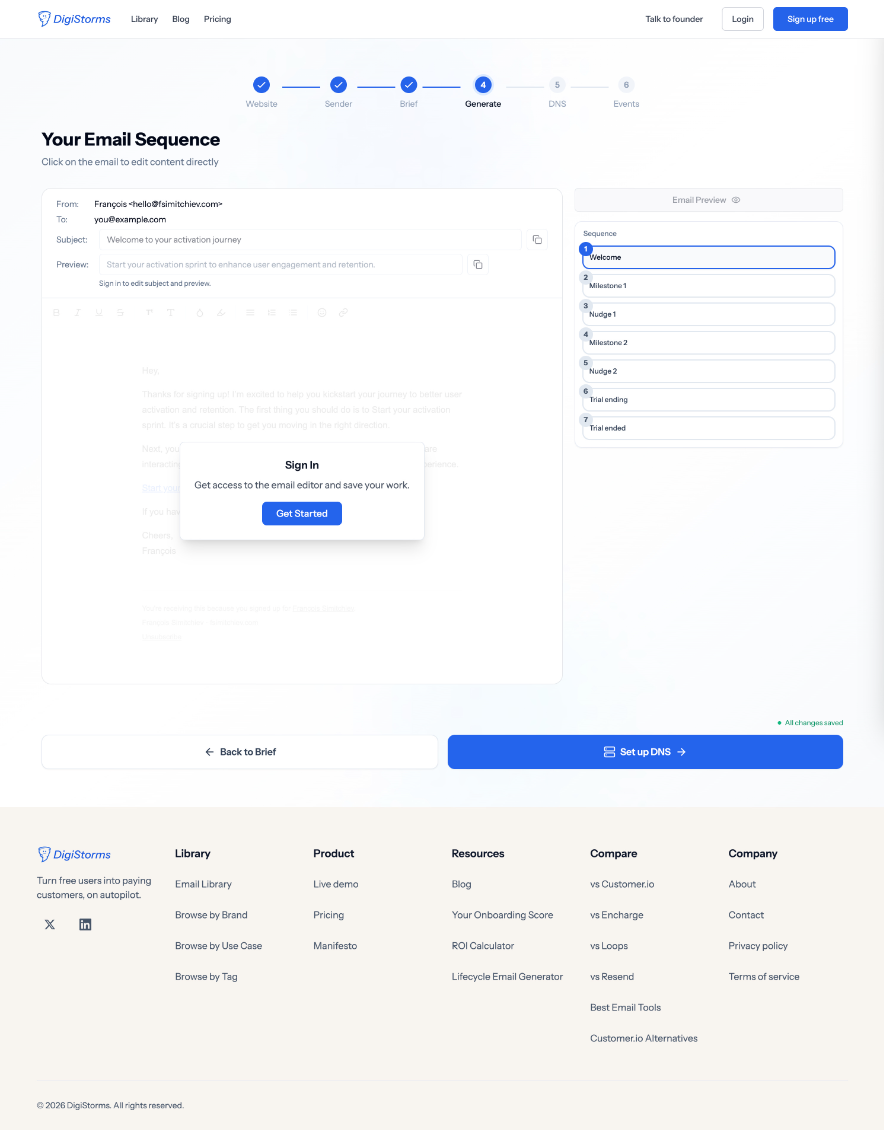
If your product can produce something useful from a single/few user input(s), do the work first and gate the rest. Don't sell the user on what your product could do. Show them what it just did. A signup that feels like unlocking is fundamentally different from a signup that feels like paying a toll.
TOP 2 — Strip the signup-to-first-milestone path of every killable step
The signup moment is sacred. It's proof a user believes your product can help them achieve X (X being something that matters to them) enough to give it a try. But that initial belief doesn't mean they're resilient to anything coming at them:
- password strength criteria with 4 unmet conditions in red
- email verification tab juggling
- "how did you hear about us?" and other marketing/profiling questions
- endless/passive product feature tour with 24 tooltips (yawn)
By the time the user reaches anything meaningful, the spark (or worse, the momentum) is gone.
DigiStorms seems to refuse this.
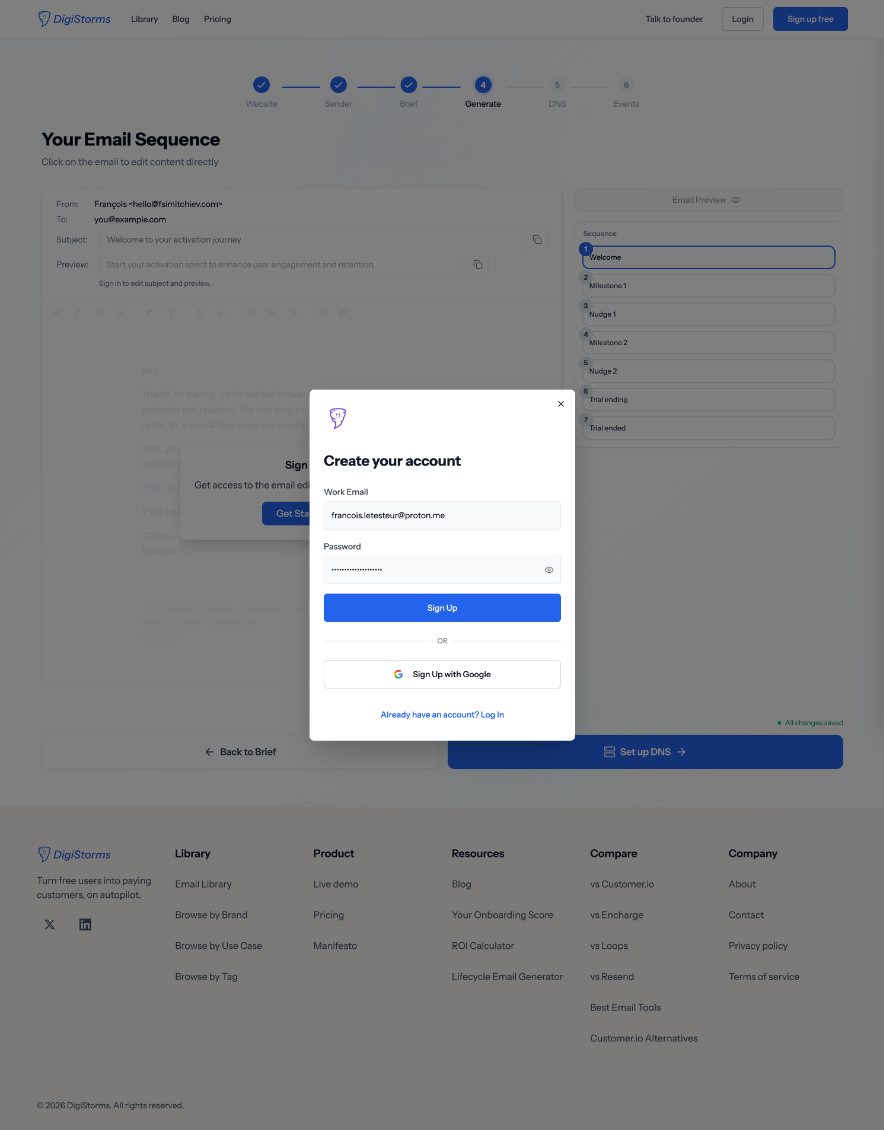
The signup itself is 2 inputs. Email and password. That's it. No first name, no company size, no "tell us about your role so we can personalize experience" (... but doesn't). The most common SSO option (Google) is also right there if you want to skip even those two fields.
The password setup has no strength criteria. No "must contain a capital, a number, a symbol, whatever". The user has agency. They can pick whatever they want and move forward.
And the most important one: there is no email verification step. You set your password and you're straight back into the product, looking at the next phase of setup. You don't have to leave the tab. Momentum: fully preserved.
According to ProductLed founder Wes Bush (and backed by their own research), email verification is one of the most underrated activation killers in B2B SaaS. The user has to leave the product, switch to their inbox, find the email (which may be in promotions/spam), click the link, get bounced back to a new tab. And somewhere in that journey, a meaningful percentage of users simply don't come back. Maybe not eveb because they changed their mind and wanted to leave, but simply because the momentum broke, and then life just kept happening.
DigiStorms removes that break entirely. The user goes from "I want to see my full sequence" to "I'm seeing my full sequence" in one continuous and seamless motion.
Every step between signup and the first meaningful milestone is friction tax. Audit your flow and ask: does this step need to be here, now? Email verification can happen later. Password criteria can be smoothen. Profile fields can be filled progressively if/when the product needs them. The cheapest way to lift activation isn't to add a better onboarding step but to remove the one that was killing momentum.
TOP 3 — Let the product do the work, so the user feels carried
Most common onboarding flow scenario is: ask the user to do things (fill this, configure that, connect this, define that). Each ask is a small extraction of effort. Stack enough of them and even motivated users can sign off.
DigiStorms inverts that dynamic. At nearly every step, the product does the work and the user reviews it. This shows up everywhere:
- generation step: the user pastes a URL, and the product produces the entire sequence. Real-time progress shows what's being analyzed. The user is watching the product work for them.
- input steps: when DigiStorms does need information, it shows a clear, value-driven why, plus a recommended path. No paralysis, no "what's the right answer here?".
- DNS/tech setup: instead of dumping a list of records to configure, DigiStorms generates an AI setup prompt the user can copy and hand to their developer or AI assistant. A possibly daunting technical step becomes a simple copy-paste.
- event tracking setup: instead of "wire these 4 events in your codebase", the product gives you the exact AI prompt + clear instructions to wire it up in one shot.
- the non-blocking "I'll do this later" escape door: if the DNS step feels too technical or needs to be delegated, the user is not blocked. They can move forward and come back. The flow accepts that real teams have real constraints.
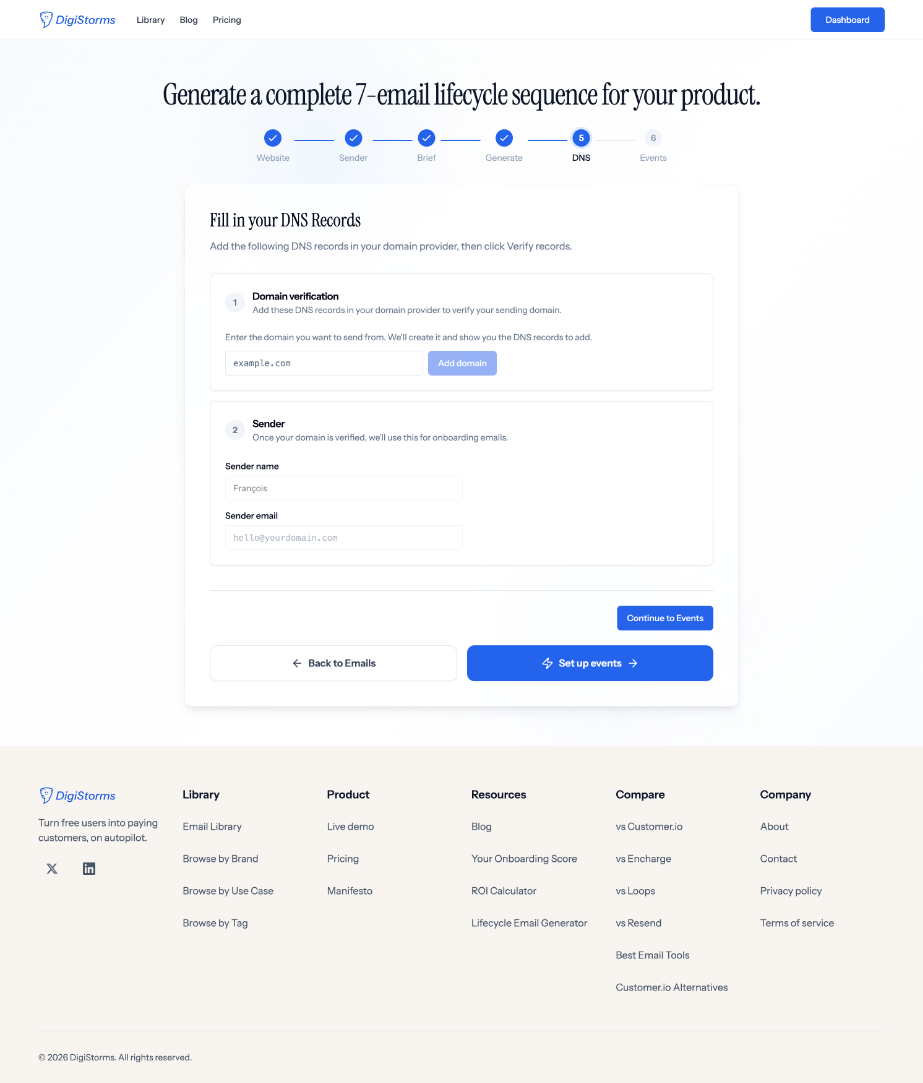
What this builds in the user's mind, beyond saved effort, is perceived competency. Each time the product handles something the user expected to handle themselves, the belief deepens: "this thing actually knows what it's doing". And that belief is the foundation of trust, retention and (eventually) willingness to pay.
There's also a behavioral economics layer worth naming: every "the product did the work" moment is also a small reward. Stack enough of them and the user enters a positive feedback loop where each step feels easier than the last. That's the opposite of how most setup phases feel.
Ask, for every step of your flow: could the product do this for the user instead of asking them to do it? Not every step can be automated, but many flows leave a lot of work on the user that the product could handle. Pre-fill what you can infer. Recommend the right path. Generate the prompts. Show the work. The fewer asks the user has to fulfill, the more competent your product feels, and the more willing they are to invest in the steps that genuinely need their input.
What to take from this
DigiStorms's onboarding works because it understands the order of operations.
90%+ of B2B SaaS products i review treat signup as the entry point and value as the reward. DigiStorms inverts it: value first, signup second, setup carried by the product. Every choice in the flow serves that inversion:
- the homepage doesn't just promise the outcome, it is the first toward delivering it. By the time you're asked to sign up, you've already seen your sequence generated, and you want to access it.
- the signup doesn't gate the experience, it unlocks the next layer of it. 2 inputs, SSO, no password criteria, no email verification. Nothing between "I want more" and "I have more".
- the setup doesn't extract effort from the user, it shows the product working. Live previews, AI-generated prompts, value-framed asks, escape doors when a step could be delayed or need to be delegated to another teammate.
The result is an onboarding that doesn't feel like onboarding. It feels like using a product that gets you to a meaningful result it promised you, within minutes and with zero unnecessary friction. Which is exactly the point.
But there's a deeper principle here, and it's the one I'd want every founder reading this to internalize: trust is not something you ask for, it's something you earn by doing the work first. The standard playbook (signup → setup → value) asks the user to extend trust before the product has earned any. DigiStorms refuses that ask. It earns the trust, then asks for the commitment. And every step of the flow is shaped by that statement.
As always, it's not just about features, or logic. It's about psycho-logic.
it's that the most powerful activation move is the one that happens before the user has signed up. If your product can produce something useful from a single input, do it. Show the user what your product just made for them, and let the signup become the moment they decide to keep it. Everything downstream gets easier when the user is already convinced before the gate.
I hope this was valuable.
PS_
Want me to review your onboarding for $0? Apply here.
I'll share a miro board with screen-by-screen annotations and top recommendations I'd work on first, and why. I'll look at it through both a strategic, user psychology and UX lens, based on the same system I use with clients.
(No commitment, no following harassment with a drip email campaign or whatever)
Senior Product Designer • Activation/Onboarding Specialist
Helping B2B SaaS founders activate, convert and retain more users
Let's talk → LinkedIn | fsimitchiev.com