
[🔬 onboarding dissection] Propal top 3 activation moves

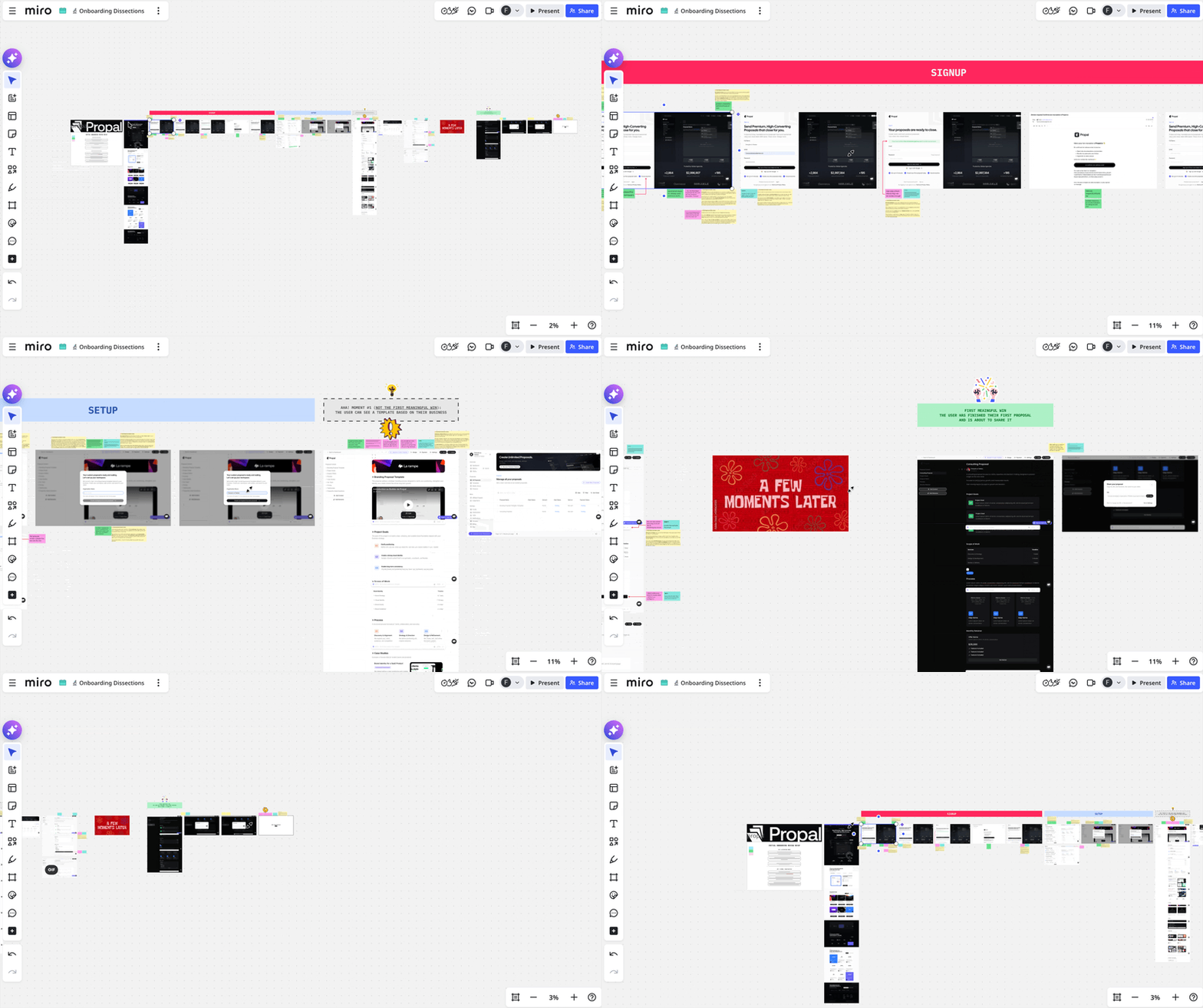
What is Propal?
Propal is a proposal builder for freelancers and agencies. The promise: create beautiful, professional proposals that get signed, fast.
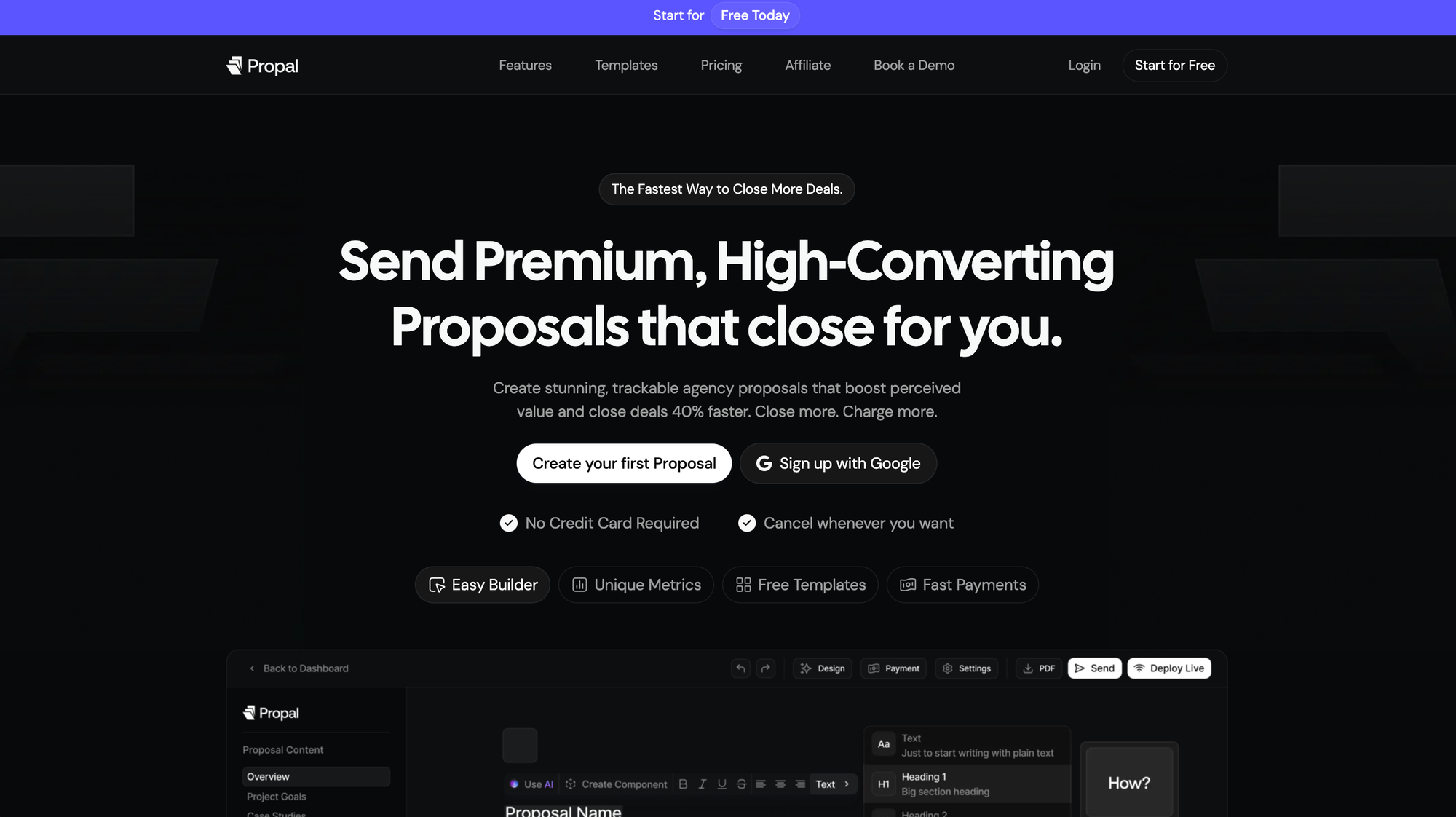
Being co-founded by a designer, I was curious about how the product would be crafter, including its onboarding. And what caught my attention is how much behavioural thinking is already baked into the flow. It's early stage, and yet...
So here are the top 3 things Propal's onboarding does really well (as always, imho).
TOP 1 — The setup flow builds commitment before asking for anything
Right after signing up, Propal walks you through 4 simple questions to configure your proposal template.
No typing, just radio inputs, max 5 options per question, and a conversational tone throughout the UI. This is deliberately low-effort, and that's the point. Each question takes seconds to answer.
And as you go through them, something happens on the right side of the screen:
Your proposal template updates in real time, based on your answers. You're watching something that looks like yours take shape. Without having written a single word.
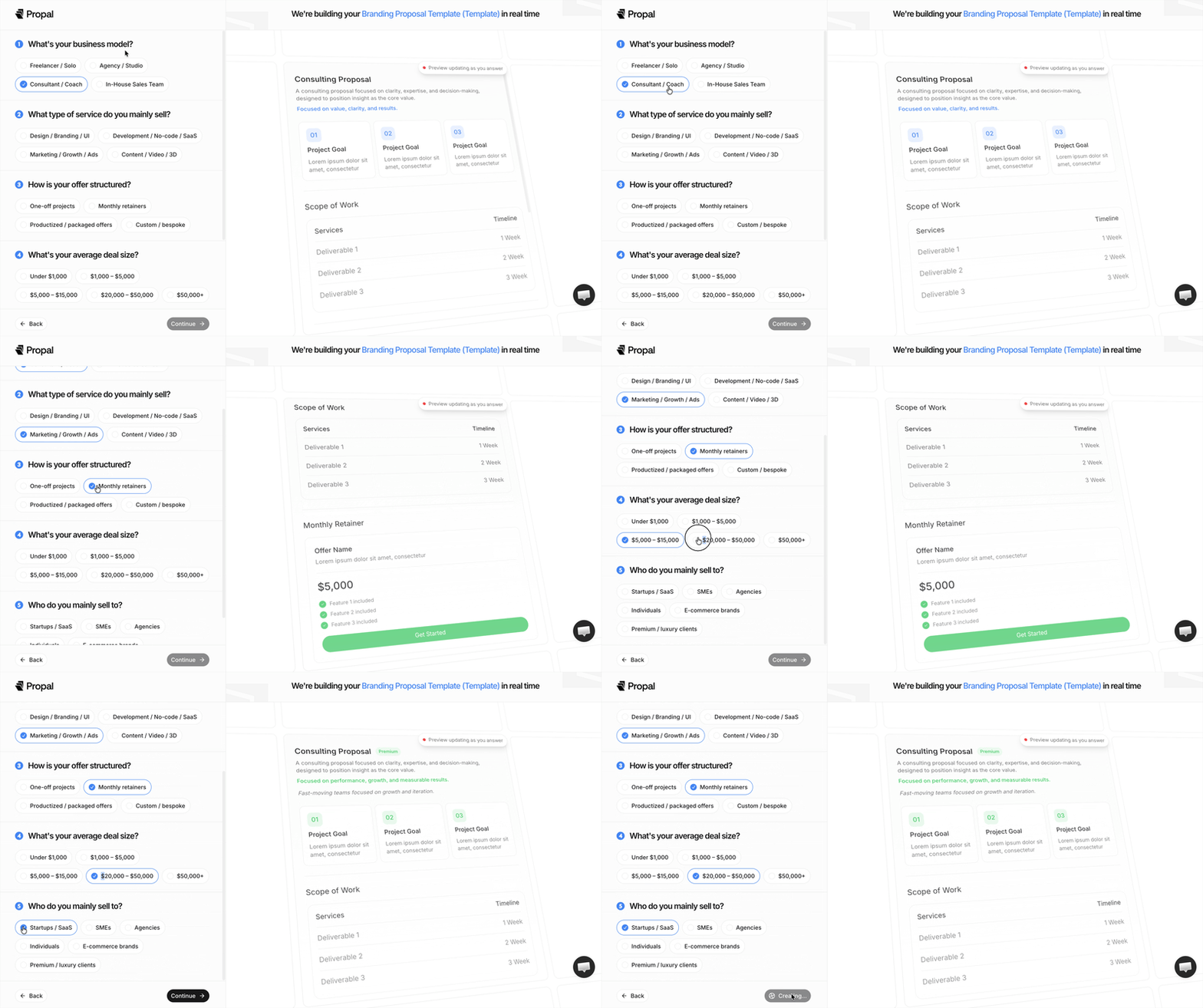
This is the IKEA effect in action: we place much higher value on things we're involved in creating, even when our contribution is minimal. By the time you reach the end of the setup flow, you've built psychological ownership over something. Walking away starts to feel like a loss.
There's also commitment & consistency at play: even lightweight interactions create a sense of investment that makes users more likely to continue. You've answered 4 questions about your business. You've implicitly declared: "I take proposals seriously". The next step doesn't feel like a new ask but like the natural continuation of something you've already started.
And by the end of the setup flow, there's one more mechanic quietly doing its job: anticipation. You've seen the template take shape piece by piece, but you haven't seen the whole thing yet. That's an open loop and your brain wants to close it. Which is exactly what carries you into the first aha! moment.
TOP 2 — Setup to first template in just seconds and a few clicks
The path from "I just signed up" to "I can see something that looks like mine" is extremely short.
4 radio-input questions, no typing, no complex decisions and a proposal template that visibly takes shape as you go (yes I've already said that);
This speed is itself an activation mechanic.
The more the first meaningful win (finishing and sending your first proposal) feels far away, the more you risk users dropping. But when it feels close and attainable, when every step is small, clear and fast, chances of users keep going increase.
This is the goal gradient effect: the closer we perceive ourselves to reach a goal, the more motivated we are to reach it. By making the first template preview just a few clicks away, Propal turns the first meaningful win from an abstract promise to something that feels reachable from the very first screen.
Top 3 — A get started checklist that ensures users stay on track and reach their first win
Once the user lands in the dashboard, Propal greets them with a dashboard checklist titled "Get started & close more deals with Propal."
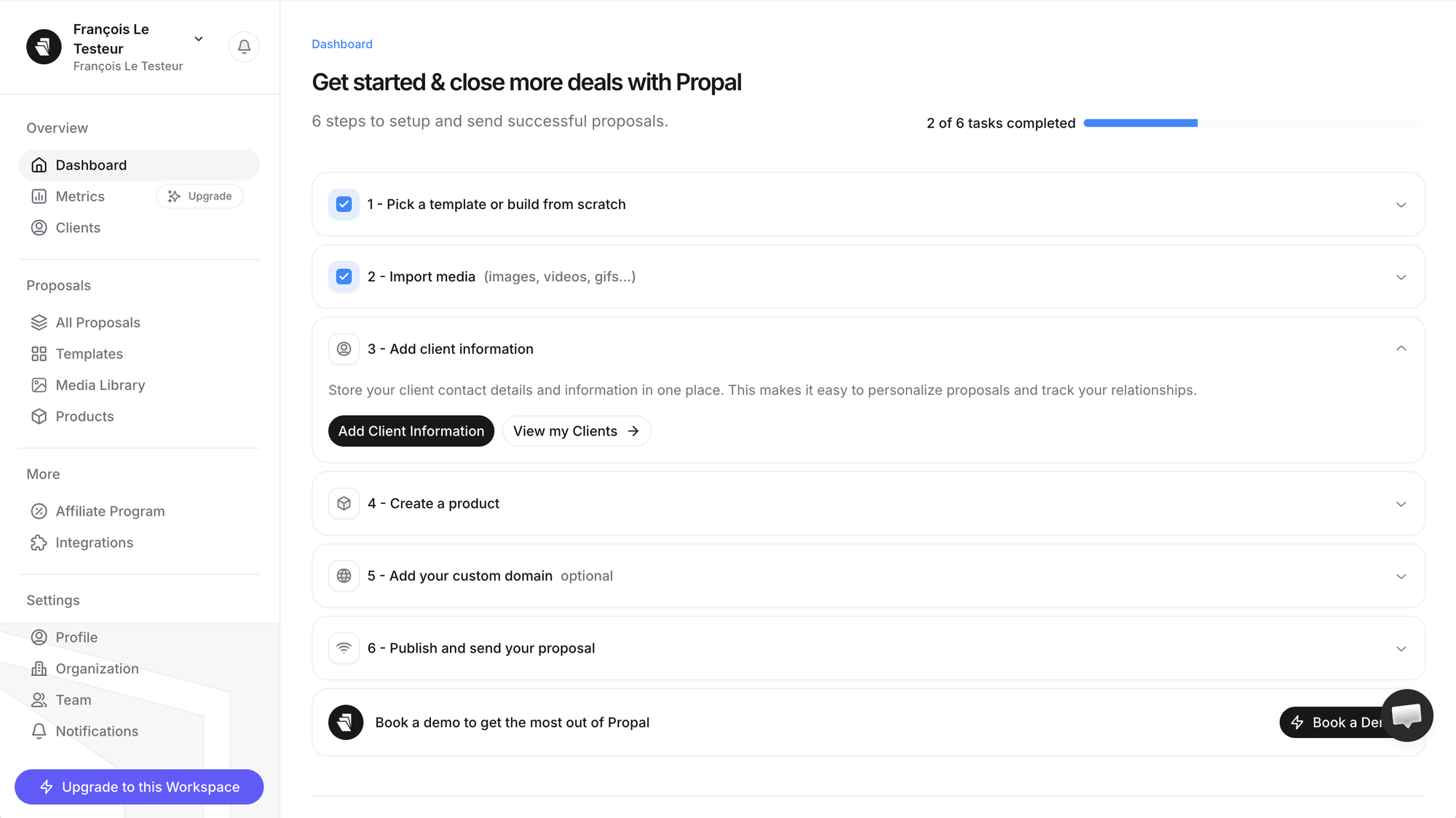
6 steps, a visible progress bar, steps 1 and 2 are already checked (because the user completed them during setup).
This is doing a lot of work from a behavioral pov.
First, it kills the "okay, now what?" moment (one of the most underestimated churn risks in SaaS). The user who reaches an empty dashboard with no clear next step often doesn't leave because the product is bad, but because they don't know what to do next. A checklist removes that ambiguity entirely.
Second, it activates the endowed progress effect: people are much more likely to complete a task when they feel they've already started it (even when the initial progress was given to them, not earned). By pre-checking steps 1 and 2, Propal isn't just acknowledging what the user already did. It's engineering forward momentum. The user arrives at the dashboard already at 33% completion. That's a very different psychological starting point than zero.
Third, it leverages the goal gradient effect again: "2 of 6 tasks completed" with a visible progress bar makes the finish line feel close. Every check brings it closer. Every return to the dashboard is a reminder that you're getting closer.
Fourth, the Zeigarnik effect works also in the background: uncompleted items create cognitive tension. The brain seeks closure and wants to complete started things. A visible checklist of incomplete tasks is a gentle but persistent pull back into the product.
And finally, each step is a single, clearly scoped action. No complexity. No decisions. Just "do this one thing". Breaking the path to the first meaningful win (a sent proposal) into small and clear tasks lowers cognitive load and increases the probability of completion at every step.
Bonus points: each item of the todo list has its own CTA, guiding users where they need to go for each action.
Oh and one last thing worth noting: the list includes a "Book a demo" nudge at the bottom. Smart placement as the user who's made it this far is already engaged, which makes this a much warmer moment for a sales touch than any cold email could ever be.
A good checklist isn't just a UI pattern. It's an activation system disguised as a to-do list.
Good onboarding isn't about any single screen, it's about the whole journey
These 3 mechanics (real-time investment during setup, a frictionless path to first value and a post-signup checklist) form a coherent activation system. Each one is designed to keep the user moving toward a single goal: finishing and sending their first proposal.
This is intentional onboarding thinking combined with smart UX and behavioral understanding (that's what designers do, not just pushing pixels).
And as always, it's not just about features, or logic.
It's about psycho-logic.
Here are the principles we covered in this article:
- IKEA effect (investment = ownership = commitment)
- Commitment & consistency (small acts create forward momentum)
- Goal gradient effect (proximity to goal accelerates motivation)
- Technology acceptance model (perceived ease of use drives adoption)
- Endowed progress effect (pre-checked steps accelerate completion)
- Zeigarnik effect (unfinished tasks demand closure)
I hope this was valuable.
PS_
Want me to review your onboarding for $0? Apply here.
I'll share a miro board with screen-by-screen annotations and top recommendations I'd work on first, and why. I'll look at it through both a strategic, user psychology and UX lens, based on the same system I use with clients.
(No commitment, no following harassment with a drip email campaign or whatever)
Senior Product Designer • Activation/Onboarding Specialist
Helping B2B SaaS founders activate, convert and retain more users
Let's talk → LinkedIn | fsimitchiev.com