
The 3 behavioral frameworks I use to maximize user engagement

Getting a someone from hearing about our product for the first time to adopting it for good is no less than a matter of behavior change. Designing great products and smart features is not enough to get people to use them. We also need to understand the invisible forces that drive behavior.
In this post I'm going to walk you through the 3 frameworks I use the most, on every project. Let's go!
Our decisions and actions are driven by emotions (how convenient is it that there is "motion" in "emotion", uh?). Logic and reasoning enter the game right after a decision has been made, so we justify it to ourselves.
Typical example: you enter your grocery store, pause at the candy shelf and pick a pack of your favourite douceur. You go back home, devour the entire thing in minutes like you hadn't eaten for the last 10 days.
And you feel guilty. So what do you say to yourself? Something like "it's okay, I had a bad day; I needed that. It's just one pack of candy, it won't kill me. I'll do more exercise tomorrow".
Sound familiar? Happens to me all the time.
Framework #1: the Technology Acceptance Model
SaaS products are not candy tho, and they're not things we crave to use.
What gets someone to a signup page is a silent YES answer to both of these questions:
- do I believe this product can be useful to me? (perceived usefulness, PU)
- do I believe it'll be easy to use? (perceived ease-of-use, PEOU)
This is the Technology Acceptance Model (TAM)
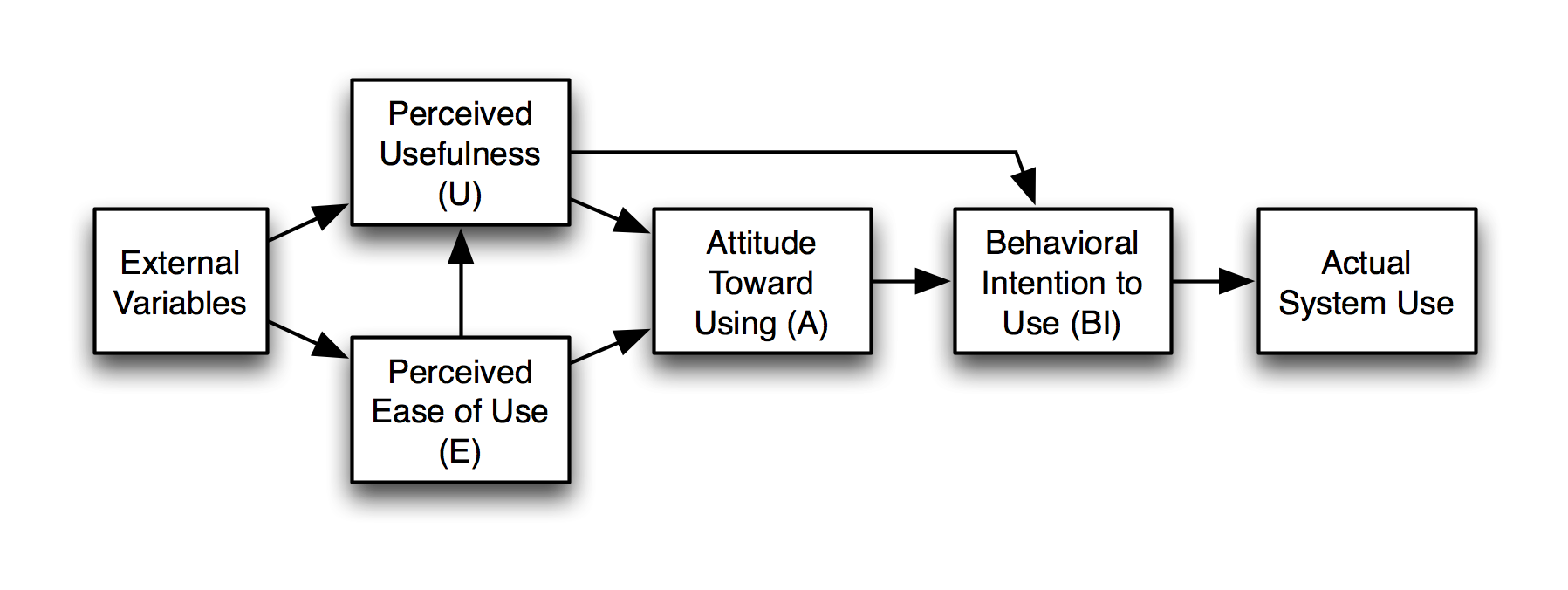
This model is particularly helpful for websites/landing pages as it forces us to ask:
- are we providing what our ideal user would need to see so they believe our product will be useful to them (in a way they can understand instantly)?
- are we showcasing how our product works so they also believe it will be easy to use? (some products may be more complex than others. If it's the case, are we at least showing how the process looks like, and that we're going to provide everything they need to use our product successfully, and win with it?)
Framework #2: the Four Forces of Change
Users believing our product can be useful to them and easy to use may not be enough though.
Because most of the times, trying your product means exposing themselves to the possibility of them adopting it for good, which can imply some costs (cost of switching) or raise some objections, fears and constraints.
Have you ever tried to get rid of some harmful habit, like eating too much chocolate or smoking? I have and it's hard. As we say in French, "habits have thick skin".
We humans also have a big tendency to prefer the current way of doing things just because it’s the default, even when better options are available.
For all these reasons, we may be relieved if we could have an understanding of all the anti-action forces that could prevent users from engaging with our product.
That's when the Four Forces of Change framework becomes handy.
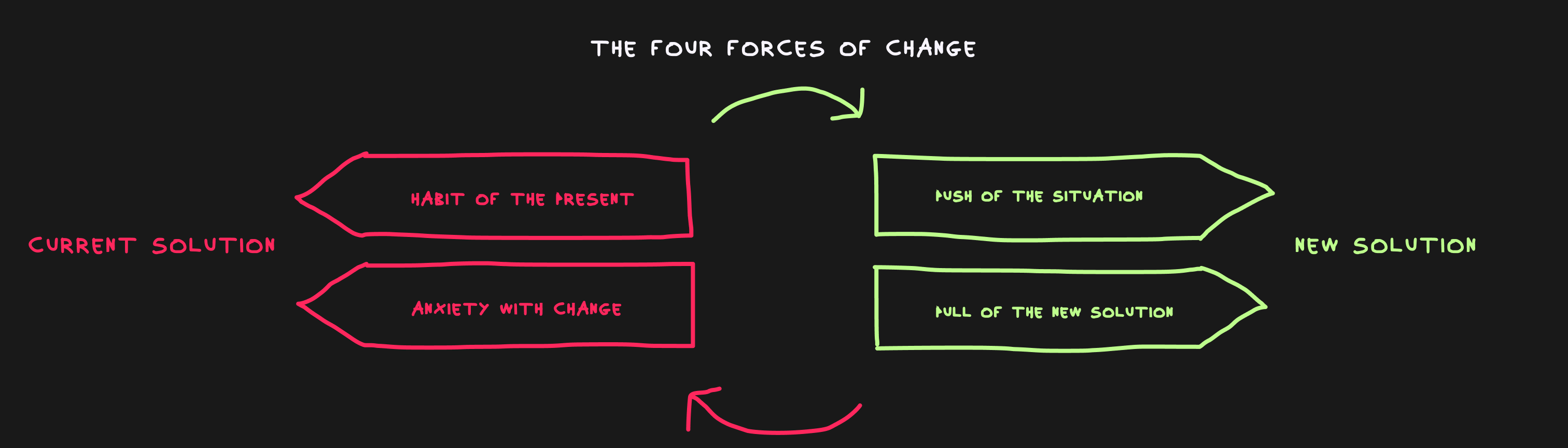
- Push of the present situation (current solution)
The frustrations or pains with the current situation that make someone want to move away from the status quo. They are either blocked in achieving a goal, or copping with a solution that has limitations and/or is painful on all levels (bugs, inefficiencies, embarrassment, stress, missed opportunities, etc.). - Pull of the future situation (new solution)
The attractive benefits of the new option: better outcomes, status, ease, speed, or satisfaction that “pull” the person toward change. - Anxiety with change (new = unknown = scary)
Fears and doubts about the new option ("will it work, will I look stupid, what if it fails, what if I lose data/money/time?") that hold people back from switching. - Habit/inertia of the present
The comfort, routines and identity tied to the current way of doing things, which make sticking to the current solution feel easier and safer than changing (even when knowing there is a better one).
The research behind this frameworks states that change happens only when the combined push + pull are stronger than anxiety + habit. So if we want users (or an entire team, department or company) to switch, we either need to increase push/pull or reduce anxieties/habit.
How do we do this in practice?
1/ Run interviews with our target users, and we look for:
- frustrations, struggle moments, trigger events
- what excites them about alternatives (pull)?
- what fears (anxieties) could stop switching?
- what routines (habit) keep them stuck?
2/ Compare our product and entire user experience against every item in the 4 forces, and design to increase push/pull and decrease anxiety/habits:
- Design to increase push/pull:
- what frustrations, pain points or blockers can we remove form their current situation/solution through our product?
- how can we make the value of our product even more understandable and help users feel they can reach a better future situation by switching to us?
- Design to decrease anxiety/habits:
- what can we do to reduce the anxiety with change and make it even easier/simpler? (ex: offer free migrations, money-back guarantees, live support, or no-credit-card-required trials to lower switching fears.)
- how can we design for familiarity (import data from their current solution, replicate UI patterns they're used to (Jacob's law), and encourage habit formation through early and repeated wins? (this is why activation and early repeat usage loops are so critical when it comes to early adoption and earning long-term retention)
At this point we may have all we need to address objections and increase the likeliness of users actually signing up to try our product.
And we also may have designed an optimal onboarding path that delivers a first meaningful win early on (ideally, within minutes during the firs-run experience).
But is there a way to increase user engagement at each step of the journey?
The answer my dear, is YES.
Introducing the behavioral model that rules them all...
(drumroll, for effect)
Framework #3: BJ Fogg's behavioral model B = MAP
Behavior = Motivation + Ability + Prompt
That's the equation. It means that for a behavior to happen, these 3 conditions must be present at the same time:
- motivation: the user understands the value they can get from doing the thing
- ability: they feel able to do the thing
- prompt: they are encouraged/remembered to take the action now
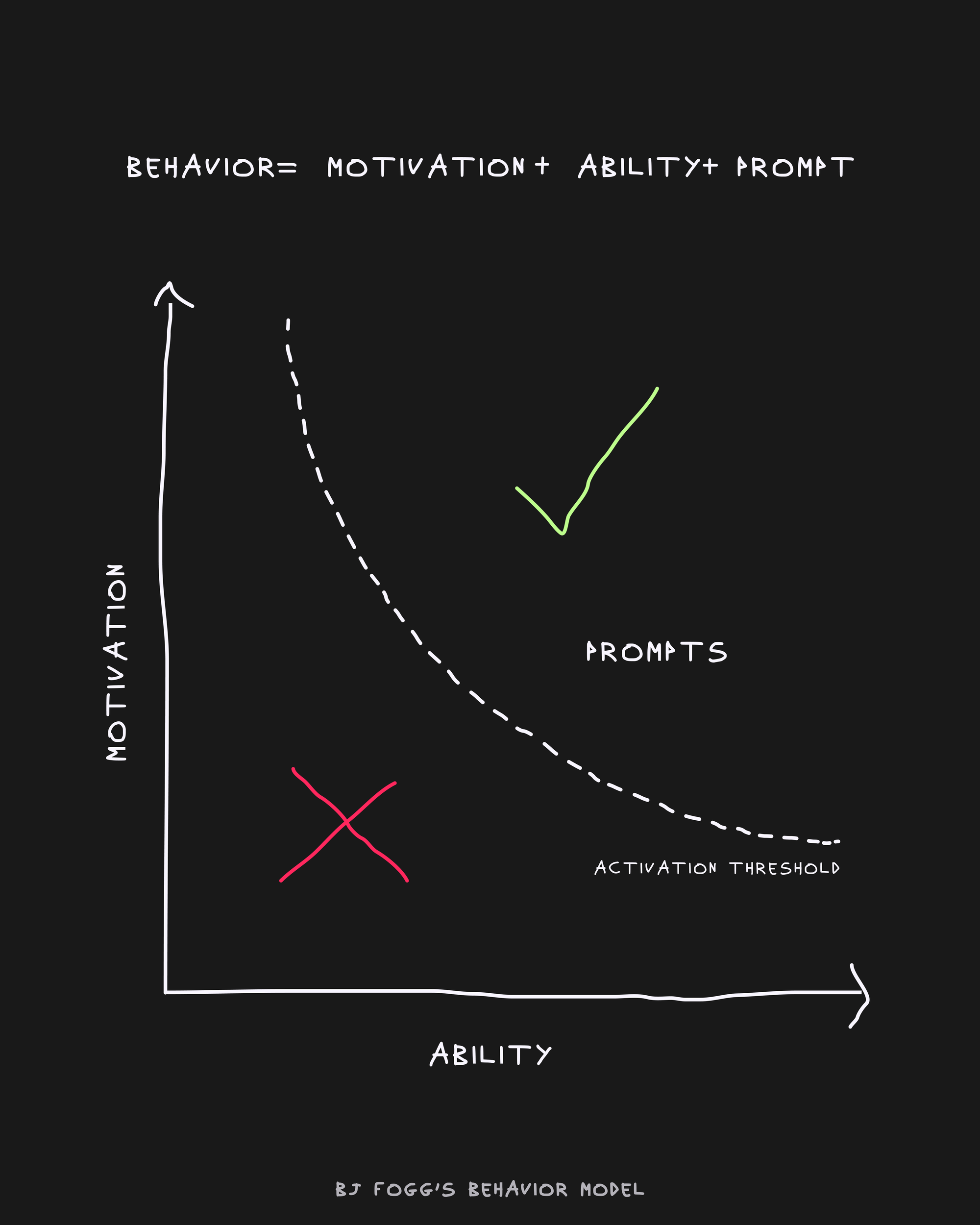
Let's take an example:
I want to build muscle, and to do so I take a subscription to the nearest gym.
Since I really want to build muscle, I have motivation. But if the gym is too far, or if it rains like crazy or if I don't know how to use the machines once there (and I'm scared I'll look dumb), I have low ability.
And even though a reminder pops on my screen know because I had made time for the gym session... I may not go. And eat chocolate instead because it's in my fridge (higher ability) and motivation to eat such a delicious thing is always high (even without an actual prompt).
Or, the gym may be super close and I may be proficient enough with few machines, but if I'm super busy and forget allocating time for my gym sessions and have no reminders popping on my phone, I may simply never make it either.
"This is nice François, but how do we apply this to our SaaS?"
It's simple. Let's take onboarding and say users need to go through 3 setup steps before getting meaningful value for the product.
For each step, we ask ourselves:
- are we making it clear why the user should take this step? do they understand how it contributes to getting them to experience value from the product?
- are we providing everything they need to feel able to take the step (in-app guidance, tutorials, social proof)?
- are we providing a timely, relevant and clear enough prompt that tells them where to get started?
This is not an exact science, but the goal is do everything we can to increase motivation and ability, and to provide a clear prompt users will see when its relevant.
Here they are, the 3 behavioral frameworks I use in all my projects.
The 4 Forces of Change to understand what we need to design to decrease anxiety with change and force of habit/inertia, and what we need to design to increase push and pull.
Then the Technology Acceptance Model to assess whether our website provides all our target users need to believe our product can help them achieve their goals and is easy to use.
And finally Fogg's behavior model to help us assess each step of the user journey against motivation, ability and prompt.
I hope this is useful, and that you see how much psychology matters for product adoption.
PS_
Want to discuss how to use these frameworks within your own product? Send me a DM on LinkedIn and let's have a quick chat.
PPS_
Want me to review your onboarding for $0? Apply here.
I'll record a short Loom walking through what I'd work on first, and why. I'll look at it through both a strategic, user psychology and UX lens, based on the same system I use with clients.
(No commitment, no following harassment with a drip email campaign)
Senior Product Designer • Activation/Onboarding Specialist
Helping B2B SaaS founders activate, convert and retain more users
Let's talk → LinkedIn | fsimitchiev.com